
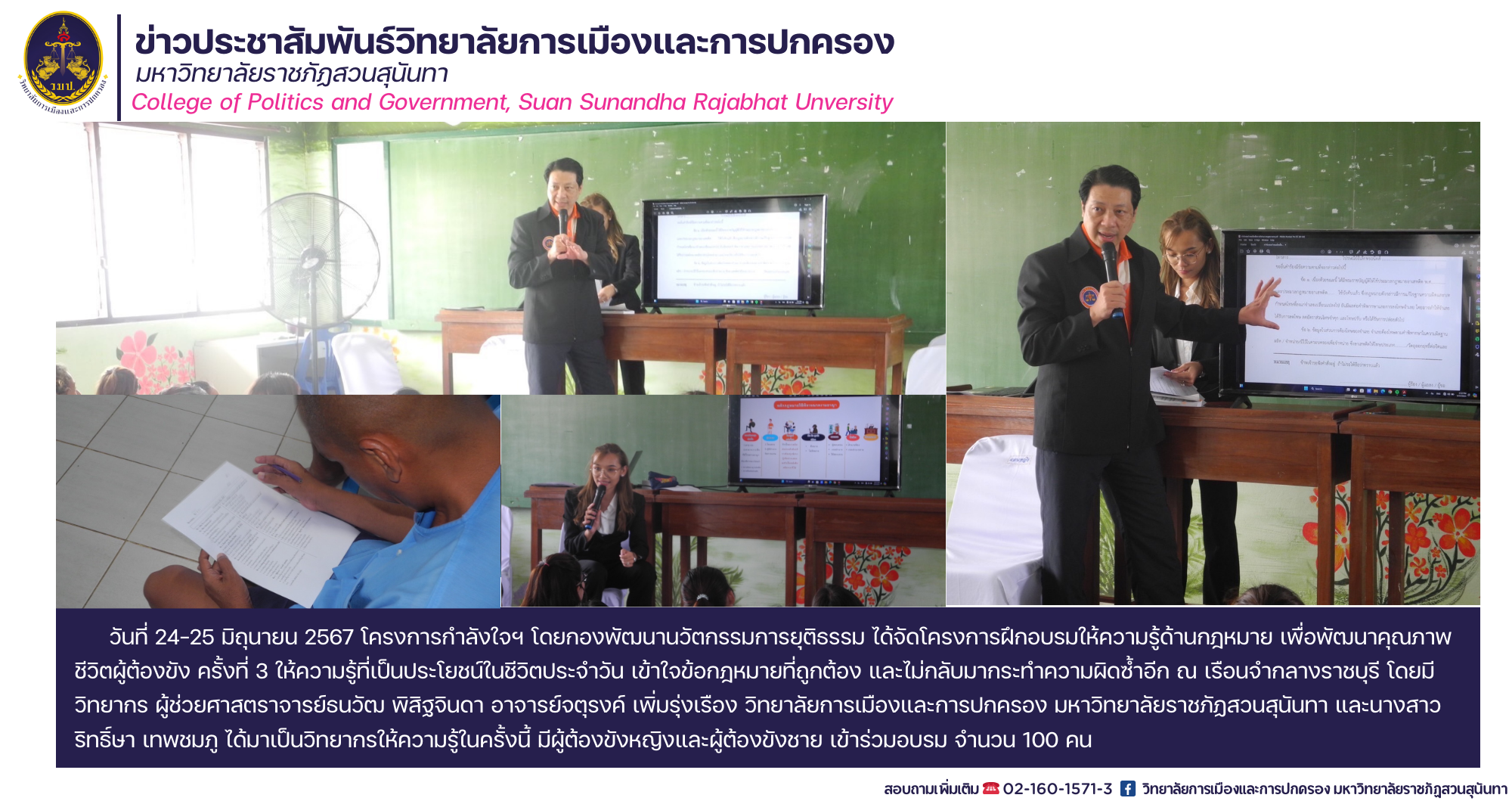
24-25 June 2024, Kamlangjai Project By the Justice Innovation Development Division Has organized a training project to provide legal knowledge. To improve the quality of life of prisoners, the 3rd time, providing useful knowledge in daily life. Understand the correct legal terms and not return to commit a repeat offense at Ratchaburi Central Prison, with lecturers Assistant Professor Thanawat Phisitchinda, Professor Chaturong Permruangruang College of Politics and Government Suan Sunandha Rajabhat University and Ms. Rittha Thepchomphu came as a lecturer to provide knowledge this time. There were 100 female inmates and male inmates participating in the training. Every time during the class, the lecturer would have the participants take a test before and after every class to measure their knowledge base.
On the 24th and 25th, the lecturer gave a lecture. Know interesting criminal procedure laws. Criminal law stipulates five criminal punishments for offenders: death, imprisonment, detention, fines, and confiscation of property. Differences between criminal cases with personal offenses, that is, criminal offenses that may occur in daily life can be classified as follows:
1. State criminal offenses It is a criminal offense which is not a personal offense. and unable to compromise on an offense that is a national crime Even if no victim has filed a complaint or no one has made an accusation, the investigating officer or police have the power to investigate and pursue criminal charges against the perpetrator.
2. Criminal offenses that can be compromised (Personal offense) means a criminal offense that is a private offense which is a compromisable criminal offense, such as an offense of embezzlement. offense of fraud and certain types of sexual offenses which according to law is a compoundable offense Which criminal offense is a compromising offense if the injured person Failure to file a complaint or report to a police investigator within 3 months is a criminal offense. Criminal offenses are divided into 3 types:
1. Intentional offenses are offenses that the offender has committed with knowledge. and desired the result or saw the result of that action, for example, Mr. Black used a gun to shoot Mr. Daeng until he died. Mr. Dam knew that he had shot Mr. Daeng. and wishes for Mr. Daeng to die Mr. Dam is guilty of killing Mr. Daeng intentionally, etc.
2. An unintentional offense is an offense committed with malicious intent. But he did not intend the result or did not see the result of his action. For example, Mr. A fired a gun and hit Mr. B causing death. Even though Mr. A did not intend to harm Mr. B, Mr. A was guilty of killing Mr. B unintentionally. etc.
3. A negligent offense is an offense committed without intention. But it was done without caution, such as the Prime Minister driving a car at high speed. This caused the car to hit Mr. Khao. who was walking on the side of the road and died, Mr. A was guilty of acting negligently, causing the death of another person. Mr. A had no intention of hitting Mr. Khao, but Mr. A drove without due care. until causing the death of Mr. White And in the afternoon there will be interesting lectures and drug laws. The participants have good intentions in this lesson. And there are questions about the punishment that you yourself received.
Cr. Kamphaengchai project page.
-----------------------------------------------
Follow
the College of Politics and dominance
Suan Sunandha Rajabhat University
Available in other channels
Website :
http://cpg.ssru.ac.th
Facebook :
https://www.facebook.com/cpgssru2023
(College of Politics and Governance Suan
Sunandha Rajabhat
University)
Facebook :
https://www.facebook.com/LocalGovernmentSSRU/
(Public Administration Department
Department of Local
Government)
Facebook :
https://www.facebook.com/POL.ONLINE.SSRU
(Bachelor of Political Science Program
Distance education system)
Facebook :
https://www.facebook.com/PublicAdSSRU/
(Public Administration Department
Department of Public Policy and
Government Management)
Facebook :
https://www.facebook.com/SSRU.PPM/
(Public Administration Department
(public and private
administration)
Facebook :
https://www.facebook.com/pla.ssru
(Police Administration
Department)
Facebook :
https://www.facebook.com/NITISSRU (Law
Department)
Facebook :
https://www.facebook.com/AdministrationcPG
(General Administration Department
College of Politics and
Governance)
Facebook :
https://www.facebook.com/CPG.edu
(Academic Department, College of
Politics and Governance)
Facebook :
https://www.facebook.com/finace.cpg
(Finance Department, Political College
and governance)
Facebook :
https://www.facebook.com/cpg.stda
(student affairs
College of Politics
and Government ) Instagram : College of
Politics and Government
E-mailssru :
CPG@ssru.ac.th
Master of Political
Science Program College of Politics and
Governance Suan Sunandha Rajabhat
University Tel: 02-160-1557,
064-827-8515
Office of the College of
Politics and Administration Suan
Sunandha Rajabhat University Tel.
02-1601571-73