
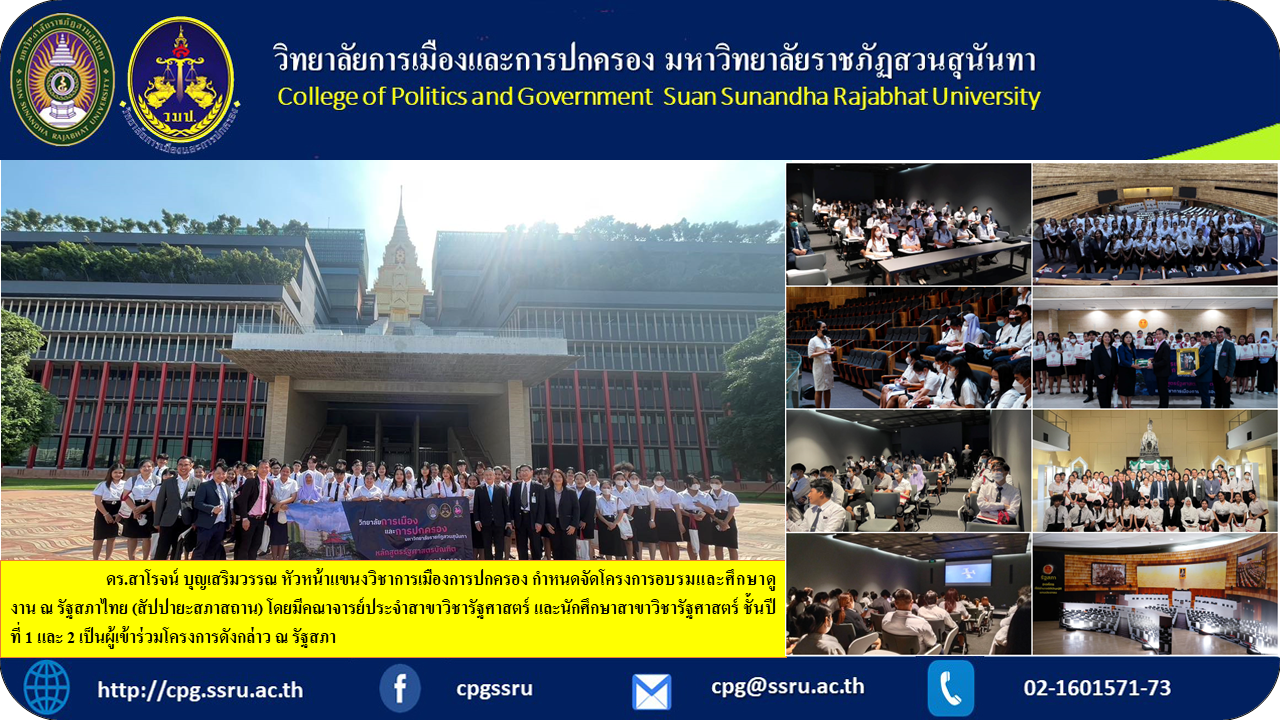
Wednesday, November 22, 2023 Dr. Saroj Bunsermwan, Head of the Political and Governance Department Scheduled to organize a training program and study tour at the Thai Parliament (Sappaya Sabha Sathan), which aims to produce graduates with knowledge, abilities, and skills that are consistent with the Thai economic, social, political, and cultural situation. Including the environment and the global social context. Have the potential to compete in work both domestically and abroad. with faculty members in the political science department and 1st and 2nd year political science students are participants in the said project at Parliament House.
 parliament
Parliament consists of House of Representatives and Senate Which has duties and powers in the legislative and other areas. Therefore, there must be authority to control the operations and administration of the parliament. That is, the president of the parliament comes from Speaker of the House of Representatives The Deputy Speaker of the National Assembly comes from the person holding the position of President of the Senate. and must have members of parliament That is, members of the House of Representatives and members of the Senate combined. When there is a joint meeting between the House of Representatives and the Senate, it is a parliamentary meeting that has specific characteristics, such as the number of members increasing because it is a parliamentary meeting in which the number of members of parliament comes from the number of members of the House of Representatives and members of the Senate combined. There are 2 people who act as the Speaker of the National Assembly, 1 person as the President of the National Assembly and 1 as the Deputy Speaker of the National Assembly. The nature of the meeting must be a parliamentary meeting and there must be a provision to hold a meeting specifically on that matter in order for there to be a parliamentary meeting. It must be an important matter for the country. very much and there will not be a regular committee set up like the regular committee of House of Representatives or Senate.
When the Constitution of the Kingdom of Thailand, B.E. 2017, has specified the duties and powers of the Parliament to be different from the Constitution of the Kingdom of Thailand, B.E. 2540 and the Constitution of the Kingdom of Thailand, B.E. 2007 in many cases, such as proposing and considering draft constitutional acts to be submitted to Parliament and have Parliament meet together to consider In the case where the opposition leader in the House of Representatives requests a general debate at the parliamentary meeting. Proposing and considering draft bills to be enacted to carry out Chapter 16 National Reform. or giving approval to a person who is suitable to be appointed Prime Minister during the first five years from the date of the first parliament under this Constitution. In this regard, the duties and powers of Parliament will be discussed as follows:
 Performance
of duties
Performance
of duties
Parliament is a constitutional organization that has specific duties and powers that affect the governance of the country and the administration of the country in many aspects, such as acknowledging or approving the succession to the throne, enacting laws, approving contracts. Approval for the declaration of war Opening a general debate to listen to the opinions of parliamentarians. which is of great importance to the country, therefore, the duties of Parliament are determined to be in accordance with the Constitution, laws and the rule of law. For the general benefit of the nation and the welfare of the people as a whole according to Section 3, paragraph two.
 Royal
section
Royal
section
In terms of the category of the King according to the Constitution of the Kingdom of Thailand, B.E. 2540, the Constitution of the Kingdom of Thailand B.E. 2007, and the Constitution of the Kingdom of Thailand B.E. 2017, there are no different provisions remaining the same.
1. In the case where the King does not appoint a Regent in accordance with Section 16 or in the case where the King is unable to appoint a Regent because he is not yet of legal age or for other reasons. But later, the Privy Council considered that it was necessary to appoint a Regent and could not inform His Majesty of the King to appoint him in time. The Privy Council shall nominate one or more persons to be a committee. In the order that His Majesty has already specified, he will be regent. Then notify the Speaker of the National Assembly to announce in the name of the King. Appoint that person to be the Regent according to Section 17. Section 156 (1) requires a meeting of Parliament to approve the appointment of the Regent according to Section 17.
2. Taking on the duties of the Regent, it is specified that before taking up the duties The Regent who is appointed according to Section 16 or Section 17 must swear allegiance at a meeting of Parliament according to Section 19, paragraph one.
3. Amendments to the Palace Rules on Succession to the Throne B.E. 2467 (1924) according to Section 20 stipulates that the amendment of the royal palace rules regarding succession to the throne B.E. 2467 (B.E. 2467) is the exclusive royal authority of the King. When there is any royal idea, the Privy Council should prepare a draft of the Palace Law amending the original Palace Law and submit it to the King for royal decision. When His Majesty approved and signed it The President of the Privy Council shall notify the President of the National Assembly in order for the President of the National Assembly to inform the National Assembly. and have the President of the National Assembly countersign the royal command. and when it was announced in the Royal Gazette to be enforced as law.
4. The summoning of the heir to the throne as king in accordance with Section 21 stipulates that in the case where the throne becomes vacant and the King has appointed the heir to the throne in accordance with the royal rules regarding succession to the throne. B.E. 2467, the Cabinet shall notify the President of the National Assembly. and have the Speaker of the National Assembly summon a meeting of the National Assembly to acknowledge and the President of the National Assembly shall invite the Crown Prince to reign as King forever. Then let the President of the National Assembly announce it to the people.
In the case where the throne is vacant and the King has not appointed an heir according to paragraph one, The Privy Council shall recommend the name of the successor to the throne under Section 20 to the Cabinet for submission to the National Assembly for Parliament's approval. In this case, the name of the Queen's daughter may be nominated. When the parliament has given approval The President of the National Assembly shall invite the successor to reign as King forever. Then let the President of the National Assembly announce it to the people.
 Meeting
aspect
Meeting
aspect
1. Closing the annual ordinary session before the expiration of one hundred and twenty days can be done only with the approval of the National Assembly in accordance with Section 121, paragraph three, that is, within fifteen days from the date of the announcement of the results of the election of members of the House of Representatives, which is general election A meeting of Parliament must be called to allow members to come to the meeting for the first time. In one year there shall be two ordinary sessions of the National Assembly, each with a period of one hundred and twenty days, but the King may grant an extension of the period. If the annual general meeting is closed before the expiration of one hundred and twenty days, It can be done only with the approval of Parliament.
The date of the first meeting shall be considered the beginning of the first annual general meeting. As for the start date of the second annual general meeting To be as determined by the House of Representatives. But in the case where the first meeting under paragraph one There is not enough time until the end of the calendar year to convene the second annual general meeting. There may not be a second annual general meeting for that year.
Calling a parliamentary meeting for members to come to a meeting for the first time must include members of the House of Representatives.
The total number of five hundred people or when ninety-five percent of the total number of members of the House of Representatives have been elected. If it is necessary to call a parliamentary meeting, then the parliamentary meeting can be called. It shall be considered that the House of Representatives consists of the existing members, but the number of members of the House of Representatives must be completed quickly. In such a case Such members of the House of Representatives shall hold office only for the remaining term of the House of Representatives.
2. The opening of the first parliamentary meeting according to Section 122 stipulates that the King summons the parliament. He opened and closed the meeting. The King will personally attend the opening ceremony of the first Annual Ordinary Session. or to appoint an heir to the throne who has reached the age of majority or any other person be His Majesty's representative You can come and do state ceremonies. When it is necessary for the benefit of the state The King may convoke an extraordinary session of the National Assembly. Subject to Section 123 and Section 126, calling a meeting Extension of meeting time and the closing of parliamentary sessions To be done by royal decree.
3. Parliament meeting In the following cases The National Assembly shall meet together in accordance with Section 156.
(1) Approval for the appointment of the Regent according to Section 17, in which Section 17 provides that “in the case where the King has not appointed the Regent according to Section 16 or in the case where the King is unable to Appoint a regent because he is not yet of legal age or for other reasons. But later, the Privy Council considered that it was necessary to appoint a Regent and could not inform His Majesty of the King to appoint him in time. The Privy Council shall nominate one or more persons to be a committee. In the order that His Majesty has already specified, he will be regent. and inform the Speaker of the National Assembly To announce in the name of the King Appoint that person as regent.”
(2) The Regent's oath of allegiance to the National Assembly in accordance with Section 19.
(3) Acknowledgment of the amendments to the Palace Rules on Succession to the Throne. B.E. 2467 according to section 20
(4) acknowledgment or approval of the succession to the throne according to section 21
(5) approval of the closing of the session according to section 121
(6) opening of the parliamentary session according to section 122
( 7) Consideration of the draft organic law in accordance with Section 132.
(8)Consultation on the draft organic law or new draft law according to Section 146
(9) Consideration and approval according to Section 147
(10) Opening of general debate according to Section 155 and Section 165
(11) Promulgation of parliamentary meeting regulations according to Section 157
(12) Statement of policy according to Section 162
(13) Giving approval to the declaration of war according to Section 177
(14), listening to clarification and giving approval to the contract according to Section 178
(15), amending the Constitution according to Section 256
(16), other cases as provided in the Constitution. For example, in the case of transitional provisions
 Law
enactment
Law
enactment
1. The enactment of constitutional bills and bills can become law only with the advice and consent of the National Assembly. The draft organic law and the draft law that has been approved by the parliament. The Prime Minister shall present it to His Majesty the King for signature. and when announced in the Royal Gazette To be enforced as law according to Section 81, that is, the proposal and consideration of a draft organic law shall be submitted to the National Assembly and the draft organic law shall be made and the National Assembly shall meet together to consider and approve it. As for the draft bill, it must be submitted to the House of Representatives first. When the House of Representatives has considered the draft bill and voted to approve it. The House of Representatives shall submit the bill to the Senate. When the Senate has finished considering the bill. If agreed with the House of Representatives Continuing to proceed according to Section 81, in which the enactment of organic bills and draft bills can only be made into law with the advice and consent of the National Assembly so that the National Assembly, which is the representative of the people, can carefully consider and approve it before If it can be enacted into law then it will be a constitutional law enactment process. According to the Constitution of the Kingdom of Siam, B.E. 2475, Section 36 states that “All Acts It can be enacted into law only with the advice and consent of the House of Representatives” for the first time.
The enactment of constitutional bills and bills can only be made into law with the advice and consent of the National Assembly, including cases where the Constitution is considered to have been approved by the National Assembly or the House of Representatives or the Senate, such as the annual budget bill. Draft additional budget expenditure bill and the draft budget transfer bill The House of Representatives must complete its consideration within one hundred and five days from the date the bill arrives in the House of Representatives. If the House of Representatives has not finished considering the draft bill within the time period specified in paragraph one, It shall be deemed that the House of Representatives approves the bill.
When an organic bill and a bill can be enacted into law, it can only be with the advice and consent of the National Assembly. Therefore, it was determined that if during the period there was no House of Representatives Regardless of the reason that the House of Representatives has expired The House of Representatives was dissolved. or any other reason There cannot be a meeting of the Senate. Except there is a case where the National Assembly has to proceed in accordance with Section 17, Section 19, Section 20, Section 21 or Section 177, or there is a case where the Senate must meet to consider appointing a person to hold a position. The draft organic law will be considered and the draft law does not include amendments to the Constitution in accordance with Section 126.
2. Proposing and considering the draft organic law shall be submitted to the National Assembly and the National Assembly shall meet together to consider the draft organic law and the National Assembly shall send the draft organic law to the Supreme Court. Constitutional Court or related independent organizations To give opinions and have the power to make amendments according to the Supreme Court's proposals Constitutional Court or independent organization In order to give opinions according to Section 132, that is, the Constitution of the Kingdom of Thailand, B.E. 2540 and the Constitution of the Kingdom of Thailand, B.E. 2007, the draft organic law shall be submitted to the House of Representatives first. When the House of Representatives has considered the proposed constitutional bill and voted to approve it. The House of Representatives shall submit the constitutional bill to the Senate for further consideration. As for the Constitution of the Kingdom of Thailand, B.E. 2017, it must be submitted to the National Assembly and the National Assembly shall meet together to consider and approve.
3. Consultation of a draft organic law or a new draft law according to Section 146, which draft law is specified? The King did not approve and returned it to Parliament. or after ninety days had elapsed, it was not given back Parliament must reconsult the bill. If the National Assembly resolves to confirm the same by a vote of not less than two-thirds of the total number of the existing members of both houses, The Prime Minister shall present the draft bill to His Majesty the King once more. When the King does not return the royal signature within thirty days The Prime Minister shall publish that Act in the Royal Gazette and be enforceable as law as if the King had already signed it.
4. Giving approval as requested by the newly appointed Cabinet after the general election to consider all draft constitutional amendments or draft laws that the National Assembly has not yet approved, which has expired in accordance with Section 147. It is stated that in the case where the age of The House of Representatives ends or the House of Representatives is dissolved. Draft constitutional amendments or draft laws that the parliament has not yet approved. or that the Parliament had approved but the King did not approve, or after ninety days had elapsed the King had not given it back. let it fall away All draft constitutional amendments or bills that Parliament has not yet approved have been dropped. If the newly appointed Cabinet after the general election requests the National Assembly to The House of Representatives or the Senate, as the case may be, will consider further. If the National Assembly approves, then the National Assembly The House of Representatives or the Senate, as the case may be, may continue consideration, but the Cabinet must request it within sixty days from the date of the first meeting of Parliament after the general election.
5. The enactment of the rules of parliamentary meeting according to section 157 stipulates that in a joint meeting of parliament, the rules of parliamentary meeting shall apply. While there are still no regulations for parliamentary meetings The rules of meeting of the House of Representatives shall apply mutatis mutandis for the time being. At a joint meeting of Parliament The provisions applicable to both Houses shall apply mutatis mutandis. Except in the matter of setting up a committee. The number of commissioners appointed from the members of each house must be in proportion to, or in close proportion to, the number of members of each house.
6. Proposing a motion and considering a motion to amend the constitution according to Section 256 (2) stipulates that a motion to amend the constitution must be submitted to the parliament in the form of a draft constitution amendment and the parliament to consider it in three sessions.
 Government
administration
Government
administration
1. In the case where the Leader of the Opposition in the House of Representatives requests a general debate at the parliamentary meeting, it is specified that in the event that there is an important problem regarding the security, safety or economy of the country. It is appropriate for joint consultation between the National Assembly and the Cabinet. The Leader of the Opposition in the House of Representatives may notify the Speaker of the National Assembly requesting that a general debate be held in the National Assembly. In this case, the President of the National Assembly must arrange to hold a meeting within fifteen days from the date of notification, but the National Assembly may. Vote on issues that cannot be debated according to Section 155, paragraph one.
2. The Cabinet that will take over the administration of the state must state its policies to the National Assembly, which must be consistent with the duties of the state. State policy guidelines and national strategy and must clarify the source of income that will be used to pay for policy implementation. without passing a vote of confidence within fifteen days from the date of assuming duties in accordance with Section 162, paragraph one.
3. The Cabinet deems it appropriate to listen to the opinions of members of the House of Representatives and senators. In the event that there is an important problem regarding the administration of government The Prime Minister may notify the Speaker of the National Assembly to request a general debate at a joint sitting of the National Assembly. In such a case Parliament cannot vote on issues under debate in accordance with Section 165.
 Aspect of giving
approval
Aspect of giving
approval
1. Approval of the declaration of war according to Section 177
2. Approval of any contract containing provisions for changing Thai territory. or extraterritorial areas over which Thailand has sovereignty or jurisdiction according to treaties or international law. Or must an Act be enacted to ensure compliance with the contract? and other contracts that may have a wide impact on the economic, social, or trade or investment stability of the country according to Section 178.
Other cases as provided in the Constitution This is the case according to temporary provisions, such as
1. Approval for the declaration of war according to Section 177
2. Draft bill to be enacted to carry out Chapter 16 National Reform To be proposed and considered at a joint sitting of the National Assembly in accordance with Section 270, paragraph two.
3. In the initial term within five years from the date of the Royal Command appointing two hundred and fifty members of the Senate according to Section 269, the consideration of a bill that has been withheld by the Senate or the House of Representatives according to Section 137 (2) or (3) shall Done by a joint meeting of Parliament. If the draft law is about.
(1) Amendment of penalties or elements of offenses against official positions or judicial positions. or the fault of an employee in an organization or government agency only if the amendment has the effect of absolving the offender from the crime or not being punished.
(2) A bill that the Senate has passed a resolution with a vote of not less than two-thirds of the total number of the existing senators has an effect. seriously affecting the judicial process.
The resolution of the joint sitting of the National Assembly approving the draft bill. There must be a vote of not less than two-thirds of the total number of existing members of the National Assembly according to Section 271.
4. During the first five years from the date of the first parliament under this Constitution That is, when the results of the election of members of the House of Representatives are announced according to the number able to hold parliamentary meetings according to Section 83 or Section 84, as the case may be, and there is a Royal Command appointing two hundred and fifty members of the Senate. giving approval to a person Who is suitable to be appointed Prime Minister must be carried out in accordance with Section 159, except for consideration of approval under Section 159 paragraph one, which must be done at a joint sitting of the National Assembly. and the resolution approving the appointment of any person To be Prime Minister according to Section 159, paragraph three, there must be a vote of more than half of the total number of existing members of both houses.
During that time If there is a case where the Prime Minister cannot be appointed from those whose names are on the list that the political party has notified under Section 88 for whatever reason. and members of both houses together amounting to not less than half of the total number of existing members of both houses submit their names to the President of the National Assembly requesting that the National Assembly pass a resolution exempting the need to nominate the Prime Minister from those present. in the list of names notified by political parties under Section 88 in such cases The President of the National Assembly shall arrange a joint meeting of the National Assembly immediately. and in the case where the National Assembly passes a resolution by a vote of not less than two-thirds of the total number of the existing members of both houses, the exemption may be granted. Continue to proceed according to paragraph one. They can nominate people on the list that political parties have notified according to Section 88 or not according to Section 272.
Thank you for information from: Thai Parliament.
Credits: Kulthida Aunjit (reporting)
Nikorn Nanthawong (photography)
-----------------------------------------------
Follow
the College of Politics and dominance
Suan Sunandha Rajabhat University
Available in other channels
Website :
http://cpg.ssru.ac.th
Facebook :
https://www.facebook.com/cpgssru2023
(College of Politics and Governance Suan
Sunandha Rajabhat
University)
Facebook :
https://www.facebook.com/LocalGovernmentSSRU/
(Public Administration Department
Department of Local
Government)
Facebook :
https://www.facebook.com/PublicAdSSRU/
(Public Administration Department
Department of Public Policy and
Government Management)
Facebook :
https://www.facebook.com/SSRU.PPM/
(Public Administration Department
(public and private
administration)
Facebook :
https://www.facebook.com/pla.ssru
(Police Administration
Department)
Facebook :
https://www.facebook.com/NITISSRU (Law
Department)
Facebook :
https://www.facebook.com/AdministrationcPG
(General Administration Department
College of Politics and
Governance)
Facebook :
https://www.facebook.com/CPG.edu
(Academic Department, College of
Politics and Governance)
Facebook :
https://www.facebook.com/finace.cpg
(Finance Department, Political College
and governance)
Facebook :
https://www.facebook.com/cpg.stda
(student affairs
College of Politics
and Government ) Instagram : College of
Politics and Government
E-mailssru :
CPG@ssru.ac.th
Master of Political
Science Program College of Politics and
Governance Suan Sunandha Rajabhat
University Tel: 02-160-1557,
064-827-8515
Office of the College of
Politics and Administration Suan
Sunandha Rajabhat University Tel.
02-1601571-73